This weekend I sat down to write the script for a live session I'm hosting before a new program of mine starts. It's a small group of people who signed up to spend five weeks building something real. And as I wrote, I kept coming back to one line I refuse to bury: we're here to build a business, not to learn AI.
That sounds obvious. It isn't. It's the single most common trap I watch people fall into.
Why "learning AI" quietly kills good ideas
Most people who want to build a business with AI start in the wrong place. They open a tool, poke around, watch a few tutorials, and feel productive. A week later they've learned some features and shipped nothing.
Learning the tool feels like progress because it's comfortable. There's always another button, another prompt, another course. You can spend months in that loop and have nothing a customer would pay for.
The problem is simple:
- A tool is a means, not a destination. Nobody buys the fact that you know a tool. They buy a result.
- Skill without a target compounds slowly. You get good at the software and stay stuck on the business.
- "I'm still learning" becomes a hiding place. It's a socially acceptable reason to never put your work in front of a real person.
AI is the best leverage a first-time builder has ever had. But leverage only matters if it's pushing against something. The "something" is a business.
What should you build first — the business or the skill?
You build the business, and you pick up the skill along the way because the business demands it.
Here's the difference in practice. If your goal is "learn AI," you'll study everything and use almost none of it. If your goal is "get my first paying customer," you'll only learn the exact thing that gets you closer this week — and you'll actually remember it, because you used it under real pressure.
That's why the program I'm running is built as a path with a finish line, not a syllabus. It moves through four plain stages:
Validate
Before anything gets built, you check that a real person actually wants it. Most failed businesses skip this and build in a vacuum.
Build the smallest version
You make the simplest thing that could possibly work — not the polished dream, the rough first version. AI makes this fast, which is exactly the point.
Get real traction
You put it in front of customers and chase the first sale. This is where "I'm learning" ends and "someone paid me" begins.
Pitch it
You stand up and explain what you built and why it matters. If you can't tell the story, you don't have a business yet — you have a hobby.
Notice that "master the AI tool" is not one of the stages. The tool shows up inside every stage as a helper, never as the goal.
Keep some decisions open on purpose
One more thing I did while writing that script: I deliberately left two details blank — a couple of numbers I haven't finalized. I'll fill them in live, once I've settled them.
That's not sloppiness. It's a discipline worth stealing. Don't bake a decision in before you've actually made it. When you commit to a number or a plan too early just to feel finished, you spend the next month defending a choice you made carelessly. Leaving a clear, marked gap is how you stay honest about what you actually know.
The same rule applies to your whole business. You don't need every answer to start. You need to know which questions are still open — and keep moving on the parts that aren't.
The takeaway
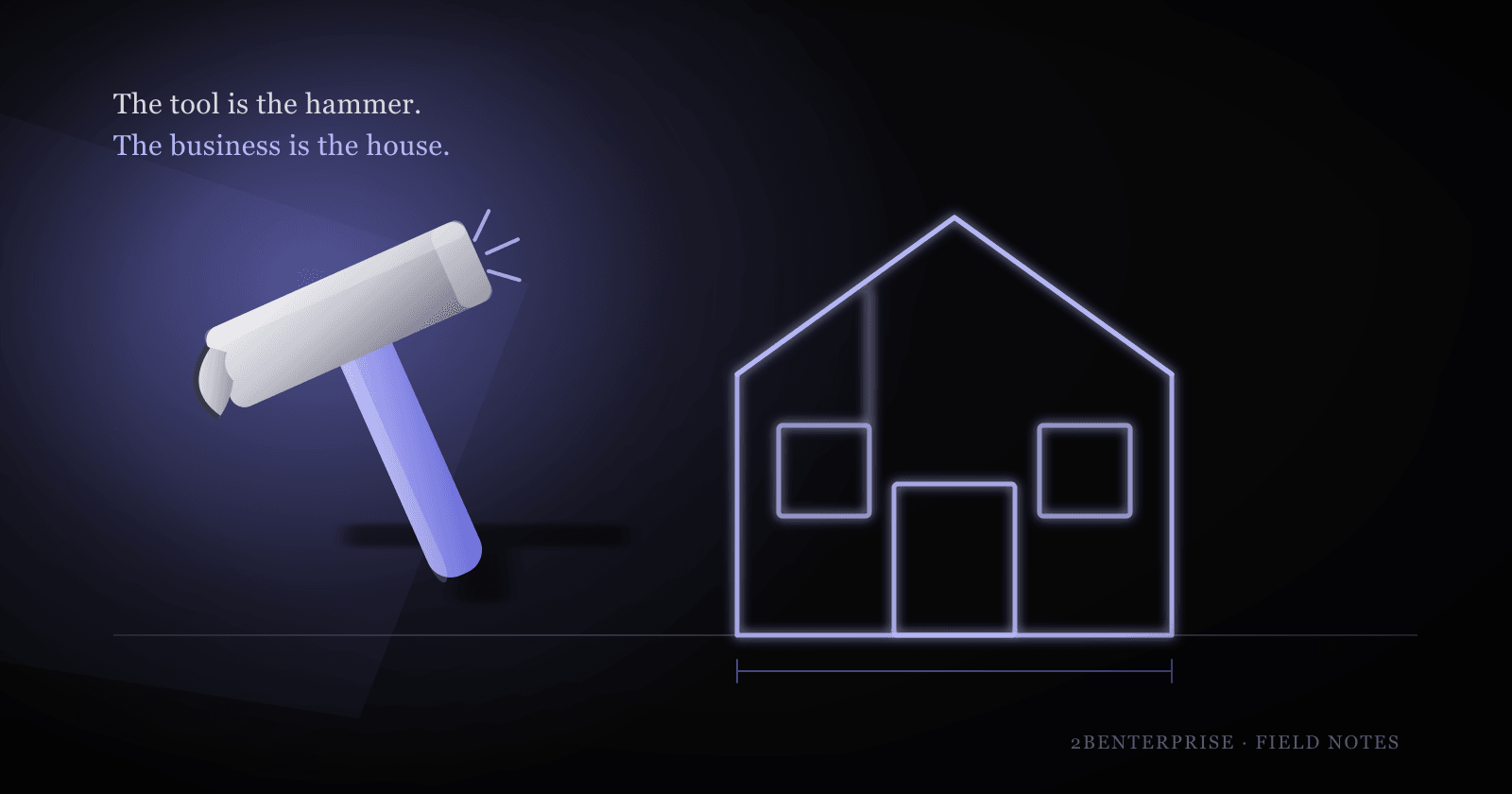
If you're trying to build a business with AI, stop measuring yourself by how many tools you've learned and start measuring by how close you are to a real customer. The tool is the hammer; the business is the house — and nobody hires you for owning a hammer.
Pick the smallest real thing you could build this month, and let the business tell you which skills to learn.